Introduction
You’re looking to put your team in the most vital position possible, but your players don’t have enough defensive experience. The 3-4-3 soccer formation is a variant of the 3-5-2 that can address this problem.
What is a 3-4-3 formation?
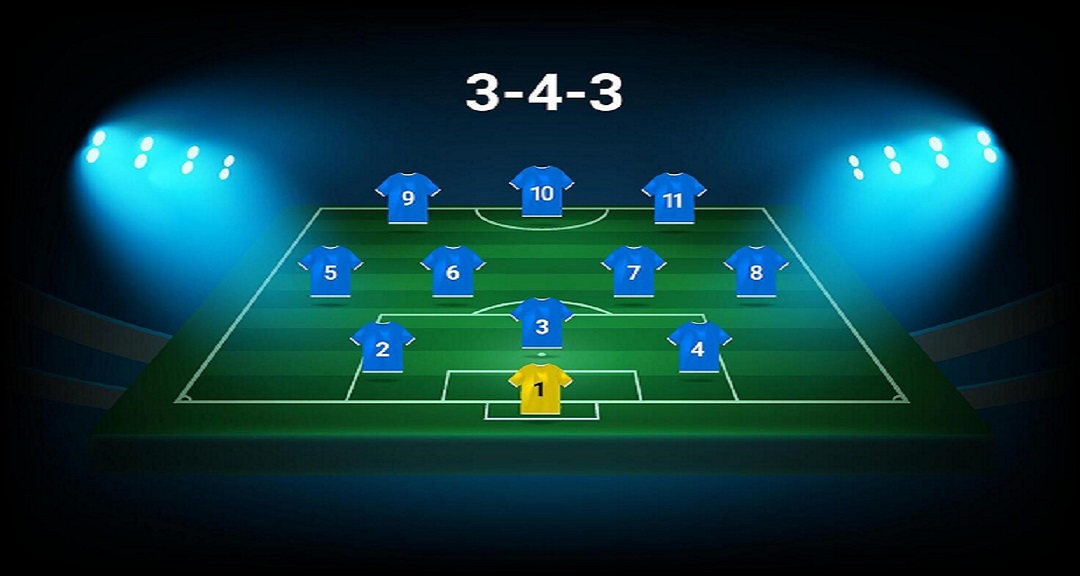
The 3-4-3 formation is a defensive formation that can be used in both attacking and defending. It is known as the Christmas tree formation because of its shape. This formation uses three defenders at the back, four midfielders in the middle, and three forwards up front.
The players are named according to their positions on the field:
- GK – Goalkeeper (Goalie)
- DR – Defender Right
- DC – Defender Centre
- DR – Defender Left
- MCF – Midfielder Centre Forward (Midfielder)
- MDL – Midfielder Defensive Line Left (defensive midfielder)
- MDR – Midfielder Defensive Line Right (right wingback)
- AMF – Advanced Forward Midfielder (left wingback).
Why use a 3-4-3?
The 3-4-3 formation is famous in soccer because it allows you to simultaneously have a strong defence and offence. The 3 in this formation refers to the three defenders, the 4 refers to the four midfielders, and the 3 refers to the three forwards on your team.
This formation is also known as a “Christmas tree” because of its shape: when you look at it from above, it looks like a tree.
Pros and cons of the 3-4-3
The 3-4-3 formation has its pros and cons. Let’s take a look at the pros first.
- The formation is best suited for teams that are good at defending, as it gives them more defensive players on the pitch than offensive players. This means that the team can defend well and not be vulnerable to counterattacks from the opposing team, who may have more attacking players than defensive ones on their side of the pitch.
- A major con of this formation is that it’s not ideal for teams who want to focus most on playing offence instead of defence because having three centre backs means you have fewer forwards than your opponent does defenders (centre backs).
Now let’s look at some of the cons:
The 3-4-3 soccer formation is defence-focused, where three defenders and four midfielders are deployed.
The 3-4-3 soccer formation is defence-focused, where three defenders and four midfielders are deployed. The three defenders are usually defenders but can also be midfielders, while the four midfielders are usually midfielders but can also be defenders. This formation uses two centre-backs (CBC) and full-backs (FBs). The outside backs play further up the pitch than their inside backs to provide width to the team’s attacks; this means they will often overlap with wingbacks when attacking.
The role of each player within the team is dependent on their position on the field; for example: *If you’re playing in goal, then you need to keep your eye on everything going on around you.*
It is also known as the Christmas tree formation because of its shape but is sometimes referred to as a 3-5-2, with three defenders, five midfielders, and two forwards.
This formation is also known as the Christmas tree formation because of its shape but is sometimes referred to as a 3-5-2, with three defenders, five midfielders, and two forwards. The difference between the two formations is simply one player in each segment: three defenders instead of four in the 4-4-2 system, five midfielders instead of three in the 4-3-3 system, and two forwards instead of one forward in both systems.
The 3-4-3 soccer formation is a variation of the 3-5-2, but with three forwards and four midfielders.
The four midfielders are arranged in a line behind the three defenders in this soccer formation. The two forwards are also organised into a line in front of them. This formation is often called a Christmas tree because it looks like one if you draw an “X.”
It is similar to the 3-5-2 soccer formation but with three forwards instead of two and four midfielders instead of five midfielders.
The three forwards combine to function as the two forwards and a single striker of the 3-5-2.
The three forwards, the two centre forwards, and a single striker in the 3-4-3 combine to function as the forwards and lone strikers of the 3-5-2. The two centre forwards function much like your traditional centre forward, except that they play wider than most formations (similar to how wide players operate in a 4-3-3). The lone striker plays up top while your midfielders work together to support both flanks.
The 4-4-2 diamond and 4-2-3-1 formations have similar benefits and disadvantages compared to the inverted triangle.
The 4-4-2 diamond and 4-2-3-1 formations have similar benefits and disadvantages compared to the inverted triangle.
The diamond (or 4-4-2) is a defensive formation designed to give maximum protection to the back four, who are tasked with defending space rather than an opponent. This means they’re much more comfortable in their half of the pitch than in attacking areas, where they can be outnumbered by opposition players looking to break quickly. The diamond’s shape also makes it easy for teams playing it to get numbers behind the ball when necessary; this makes them more effective at disrupting attacks.
However, playing with three central midfielders leaves you vulnerable when facing sides who play with wide forwards or wingers—significantly if those wide players can cut inside onto their favoured foot—as there’s no one left defensively minded enough for them to track back onto during counterattacks or direct balls into space behind you defence (like crosses).
This setup is designed for offence and does not allow for much defence if you lose possession; however, it can be very effective in allowing a team to maintain offensive pressure on their opponent.
This setup is designed for offence and does not allow for much defence if you lose possession; however, it can be very effective in allowing a team to maintain offensive pressure on their opponent. The 3-4-3 is a defensive formation that gives the team a lot of defensive covers. It’s not a good formation for attacking because there’s no real striker up top. You’ll want to use this setup when playing against weaker opponents or teams with weak defences (and don’t worry about having too many players back).
Takeaway:
If your team has strong midfielders and a solid defence, 3-4-3 is a good formation for you. However, it’s not particularly defensive, so it works best if you have a lot of skilled players on offence. This formation can be used in Champions League and Europa League matches.
Conclusion
The 3-4-3 soccer formation is a variation of the 3-5-2, but with three forwards and four midfielders. The three forwards combine to function as the two forwards and a single striker of the 3-5-2. The 4-4-2 diamond and 4-2-3-1 formations have similar benefits and disadvantages compared to the inverted triangle. This setup is designed for offence and does not allow for much defence if you lose possession; however, it can be very effective in allowing a team to maintain offensive pressure on their opponent.