Introduction
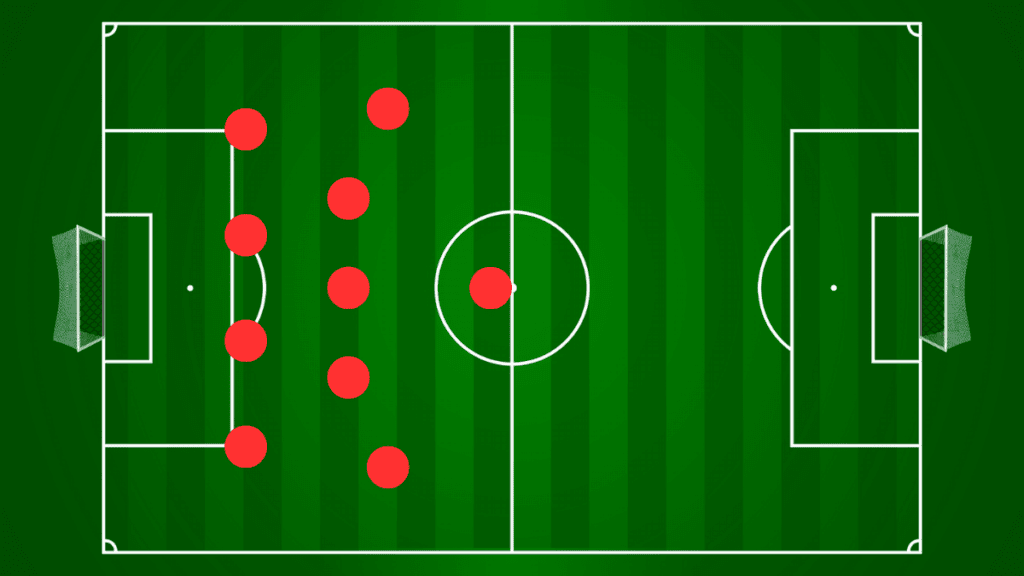
The 4-5-1 soccer formation is one of the most famous formations in modern soccer. It’s a balanced setup that can be played with either attack or defense in mind, depending on your available players. The 4-5-1 formation involves a row of four defenders, a row of five midfielders, and one forward.
This formation is famous in the modern game.
The 4-5-1 formation is famous in the modern game. It was first developed by Jose Mourinho when he was manager of Porto, with Luiz Felipe Scolari using it to win Brazil the 2002 World Cup. The 4-5-1 formation has been used by teams like Manchester United to significant effect and by Barcelona and Spain under Pep Guardiola, who won 14 out of 18 games when using this system.
The reason 4-5-1 works so well is simple: if one player goes forward, there are always five players behind, ready to defend their goal from any counterattack. Because four defenders can drop back into deeper positions if necessary, this makes it hard for opponents to score against teams that play this way.
The 4-5-1 formation involves a row of four defenders, a row of five midfielders, and one forward.
The 4-5-1 formation involves a row of four defenders, a row of five midfielders, and one forward. The number in the form’s name indicates how many players are in each row; in this case, there are four defenders, five midfielders, and one forward.
The midfielders act as both attacking and defensive players depending on the situation during a game. They also have to be physically strong enough to win tackles against their opponents and mentally sharp enough to find open spaces when their team has possession of the ball.
Balance is key to the 4-5-1 soccer formation.
The 4-5-1 formation is flexible and can be used for attacking or defending. The key to the success of this formation is in establishing balance. The front four players are responsible for creating more opportunities for the striker and will often look to get goals themselves if possible. They should also be able to defend well when needed, but preferably against only one attacker at a time.
The back five players should have good defensive qualities and be able to hold onto possession when under attack from opposing teams. This can help your team maintain possession so that they can switch positions quickly after scoring or conceding goals, enabling them to keep up pressure on their opponents with quick transitions rather than having long periods where they are unable through lack of numbers in attack or defense.
A way to play defense, midfield, and offense in a balanced way
It’s a good formation to use if you want to play defense, midfield, and offense in a balanced way. It’s also good if you have strong defenders who can win the ball high up the field and pass it quickly to your attackers. You can also use it if you like fast-paced football with lots of movement by all 11 players on the pitch.
You may want to use this formation with players who can make runs into space behind opposing defenders or dribble past them, so they can get behind the defensive line when attacking corners or free kicks near your penalty area (see diagram below).
Right Fullback: The fullback will defend the right side of the pitch and will push forward into midfield in possession.
- The right fullback will defend the right side of the pitch and will push forward into midfield in possession.
- He should be a good passer capable of making runs to support attacking moves.
Goalkeeper: The goalkeeper will take up his usual position between the posts.
Goalkeeper: The goalkeeper will take up his usual position between the posts.
Center-backs: The two center-backs will stand side by side in front of the goal, one on either side of the goalkeeper.
Fullback: One fullback will stand behind and to one side of center-back A and another behind and to one side of center-back B.
Center Backs: The center backs will be aware of their defensive responsibilities and make sure to clear any crosses or through balls from the defenders.
The center backs will be aware of their defensive responsibilities and clear any crosses or through balls from the defenders.
The two center backs are the last line of defense, so they should be good in the air and able to tackle hard. However, they also need to be quick on their feet as they’ll need to cover a lot of ground when they switch positions with one another on defense (the left back becomes right back and vice versa) or when defending against counterattacks.
Left Fullback: The fullback on the other side of the pitch will also defend his side and push forward in possession.
Left Fullback: The fullback on the other side of the pitch will also defend his side and push forward in possession.
Middle Midfielder: The central midfielder is a key player; he should be able to defend and attack. He should have good stamina, pace, and technique.
Right Winger: This player will constantly challenge for the ball from deep positions, so he should have good stamina and pace, and skillful dribbling abilities.
Defensive Midfielders: The defensive midfielder has many jobs, as he must screen his back four and make interceptions when needed. He also needs to be involved in attacking play by providing an outlet for counter attacks or moving forward with possession.
The defensive midfielder is an integral part of the 4-5-1 formation because he needs to be able to fill in at either central midfield or center back if need be. In addition, he should have a relatively specific role within the system: screen his back four and make interceptions when needed. He must also provide an outlet for counterattacks and be involved in attacking play by moving forward with possession.
The two remaining midfielders are known as “box-to-box” players because they alternate between attack and defense throughout the match. These players’ primary roles are to help dictate play and cover their teammates when necessary, which means that they must possess quickness and endurance in addition to technical ability on the ball.
Central Midfielder(s): The central midfielder will sit in front of his defense and provide cover while creating chances for those ahead of him by using passes or dribbling past opponents.
Central Midfielder(s): The central midfielder will sit in front of his defense and provide cover while creating chances for those ahead of him by using passes or dribbling past opponents.
A midfield trio is the most common midfield formation. For example, two players play as center midfielders, one just behind the other, with one more at a wider position to the left; this formation is also known as 4-3-3-0.
Right Winger: The right winger should look to cut inside at any opportunity and support his defender out wide when needed.
The right winger should look to cut inside at any opportunity and support his defender out wide when needed.
If you have a quick and technically gifted winger on your hands, encourage him to dribble with the ball while making runs inside at every opportunity to create space.
Striker: The lone striker is responsible for taking chances on goals whenever they arise while remaining a constant threat up front.
The lone striker is responsible for taking chances on goals whenever they arise while remaining a constant threat up front. This player should be a good finisher and have a strong vision since he’ll receive passes from midfielders and connect with the midfielders or wingers in attack.
The striker will play alone up top, with no other players directly ahead of him. This role requires a lot of work; to be successful, you must possess excellent technical skills and exceptional off-the-ball movement and positioning. Your job is to get behind opposing defenders by taking advantage of space created by teammates’ runs or by opening up passing lanes yourself through intelligent dribbling or creative combinations with your teammates (see “Passing” below). In addition to scoring goals yourself, it’s also essential that you create opportunities for others by making runs towards the goal after winning back possession deep in the opponent’s territory—this will pull defenders out from their positions which creates space for other players on your team who may not be comfortable dribbling at high speed but still want an opportunity to score.
A formation that utilizes one striker up top supported by three midfielders behind him
- The 4-5-1 formation is a defensive tactic that utilizes one striker up top supported by three midfielders behind him. The lone striker is usually more of an attacking player, while the remaining midfielders are more defensive.
- This formation can be adapted to work as a 4-4-2 or a 3-5-2, depending on who you have in your squad and how they play.
The four defenders are split into two outer “fullback” defenders, one central “sweeper” defender, and one central defender.
The four defenders are split into two outer “fullback” defenders, one central “sweeper” defender, and one central defender. The two fullbacks are positioned on the flanks of the formation. They are primarily responsible for delivering crosses from deep positions but can help in defence and midfield if necessary. The sweeper is responsible for covering any attackers that get past your defensive line and will often drop as low as possible to sweep up loose balls when they fall near them. A good sweeper should be able to mark an opposing striker effectively while moving diagonally across the pitch with them so that they don’t get isolated by being caught flat-footed on one side of the field when play switches quickly back toward that side of things after being dominated by another player’s attacking move earlier in play.” To get started with this type of soccer formation,” says coach Jack Cooper Smithson.” You need four players who can operate at their best around both ends of your team’s defensive line.”
The five midfielders include three midfielders at the front of the formation, who support the forward and act as attacking players when possible, and two more defensive-minded midfielders stationed behind them.
The five midfielders include three midfielders at the front of the formation, who support the forward and act as attacking players when possible, and two more defensive-minded midfielders stationed behind them. The latter should be able to break down an opponent’s attacks before they get started so that your team can keep possession better.
3-4-3 soccer formation: In this type of formation, there are three defenders, four midfielders, and three forwards.
The formation is intended to create a balance between offensive and defensive playing styles.
This formation is intended to create a balance between offensive and defensive playing styles, making it ideal for teams that want to focus on attacking in the first half and then switching to a more defensive approach in the second half.
It works best when you have players who can play multiple positions, but if you don’t have such players (and most teams don’t), then consider your team’s strengths and weaknesses before deciding which style will work best for them.
In this setup, an even number of forwards can help take pressure off the single striker in the lineup.
In this setup, an even number of forwards can help take pressure off the single striker in the lineup. A second forward means that the center midfielders don’t have to worry about tracking back so far when the ball is lost and can play more offensively instead. It also gives your team more depth and balance, allowing you to adjust formations depending on which players are on hand at any given time.
Conclusion